Learn To Ice Skate
~ and love the glide ~
Work Hard • Dream Big!
From Beginner to Advanced
Learn To Ice Skate
I teach in Fort Collins, Colorado at EPIC - Edora Pool Ice Center at 1801 Riverside Ave. I'd love to set up a lesson time where we are on the ice together. This is the most traditional lesson in that I can, for example, physically hold your foot and ankle to help you "feel" what position you need to be in.
My lesson rate is $75/hour and you will need to purchase a lesson ticket from the EPIC front desk for however long our lesson is - usually 30 minutes but it can be shorter or longer. You also need to purchase your ice time admission from the EPIC front desk for the session your lesson will be on (ie: public session called "open skate", freestyle session called "contract ice" or fitness session).
Note: Lessons can also be online using FaceTIme or Zoom. And you can see my lesson calendar above but only I can change it. So if you want a lesson, find a time on my calendar that works for you and use the form below to request to be added in.
Basic Skills / Beginner
Ice skating lessons for all ages / abilities. Where students will learn how to fall and get up safely, go forwards, backwards, 1 foot glides, jump, stop and spin. Lessons for both figure skating and hockey skills!
Skating Skills / Advanced
Advanced skating lessons for all where students learn forward / backward / inside / outside edges, turns that go with and counter to a circle and challenging transitions from backward to forward. Low level jumps and spins too!
Ice Dancing
These lessons focus on flow, edge quality, power / speed all while dancing with the music. Several rhythms are taught to expand a skater's musicality. All level of pattern dances and solo free dances. Ice dancing can be done solo or with a partner.
Types of Ice Skating Sessions
PUBLIC [AKA: Open Skate / Public Session]:
Anyone can skate. Beginners welcome!
FS [AKA: Freestyle / Contract Ice]:
Skaters at Basic 4 and above. Skaters should be able to do forward crossovers and stop safely going backwards.
FITNESS [AKA: Fitness Skate]:
Skaters 16 years and older. Beginners to advanced welcome!
Private Lesson Cancellation Policy
Excluding an emergency, please give me 24 hours notice if you wish to cancel a scheduled lesson. It's a courtesy to do this. That then gives me time to contact other skaters to offer that lesson time to them.
I expect payment for any lesson that is a "no show" or when I'm given less than 24 hours notice of a cancelled lesson.
I'm reserving lesson times for you and you are expected to keep your commitment each week. Skaters that cancel or reschedule standing lessons frequently will lose the privilege of holding standard lesson times.
Complete this form to schedule a lesson.
Tell Coach Katie what your skating goals are.
Who Is Coach Katie?
Resume & Story
- Certified Rated in Ice Dance, Group & Skating Skills
- United States Figure Skating [USFS] member since 1978
- Competed in the US Championships in Junior Dance
- Coached skaters through Gold tests in Skating Skills, Pattern Ice Dance & Solo Free Dance
- Taught group & private lessons at EPIC in Fort Collins, Colorado since August 2016





Articles of Wisdom
[ Bits of advice for skaters of all ages and abilities! ]
So your coach says you’re ready to test your Pre-Preliminary Skating Skills test, your first United States Figure Skating (USFS) test on your way to becoming a "gold medalists" and possibly competing at the US Figure Skating National Championships… now what? How do you sign-up? Who are the judges? What do you wear? How does this work?
Sign-up to test:
Hopefully you are a member of a USFS through your local club or as an individual member. If you are not, you will need to join. Most clubs have a variety of membership options so make sure to check that you have a membership that allows you to take a USFS test. Memberships start July 1st.
You’ll probably need to sign-up for your test online and provide your coach’s contact info. This is so the test chairman of the club can check with your coach to confirm that they approve of your test.
How a test session works:
You might consider watching a Pre-Preliminary Skating Skills test either live at your club’s test session and/or on YouTube. It helps to understand how the rhythm of a test session goes and the protocols that you will be expected to follow. It does vary slightly from rink to rink, state to state, but generally the judge (or three judges – depends on your test chairman’s preference and the availability of the judges) will call the skater over to the side of the rink. Here they confirm your name to make sure they are marking the correct person. Sometimes they’ll go over the order of the moves and ask if you are ready. This is your first impression. Be confident. Speak up. Answer any questions they ask you. Then go perform your test as you have practiced it.
Another variable could be that there might be other skaters testing at the same time you are. This too depends on your test chairman’s preferences, the availability of judges and the amount of ice time allotted for the whole test session. If there are other skaters on the ice testing at the same time you are do your best to avoid a collision. Sometimes a judge will “direct traffic” and tell the skaters when to go to perform their next move.
The important thing is to show the judges your skating. You might have to use a different line to do your edges. You might be directed to use a different part of the ice for your Waltz 8. Be flexible. You should be able to do any part of the test on any part of the ice and any direction. This will help relieve your stress on test day.
On YouTube there are lots of tests you can watch. Make sure to confirm with your coach which ones they want you to watch. Sometimes the skater might have a different technique or slightly altered pattern from what you were taught. That’s normal. There are various right ways to do things. But check with your coach to confirm. And remember, not all YouTube videos are of passing tests… some are fails (or retries). You can learn a lot from watching retries too!
The judges come to your test assuming you are going to pass. Why would you have signed up if you didn’t think you were going to pass? But they also understand nerves. Show them what you have practiced with confidence. If you show them what they are expecting to see they will pass you. Many of them either were skaters or are currently skaters. They understand how scary it can be to test but they do need to see your moves skated correctly. They are volunteering their time to evaluate your performance and want to pass you, but will only pass you if your skating is to the standard or above.
About a week before the test session a schedule should be posted or sent to you. Check to make sure you are on the list and scheduled to take the correct test. Arrive at the test session about 1 hour before your warm-up time. As soon as you arrive check in with the ice monitor to see if the test session is running on-time. Also check in with your coach so they know you are in the building.
On ice warmups vary in length so make sure to check with your coach to find out what you should do on your warmup.
Atmosphere:
The atmosphere of a test session is usually serious and quiet. The person on the ice is the focus. You should warm-up quietly and not distract the skater or the judges. There are also lots of emotions at a test session. Be aware of the various situations and be respectful of their space. It’s not proper to ask a skater who has tested, “Did you pass?” You are putting that skater on the spot. Focus on your test and let the other skaters do the same. You can find out through your coach or online later the results of the other testers. However, if there are smiles, congratulations, and shrieks of joy because someone has passed a test you can certainly go congratulate them.
Results:
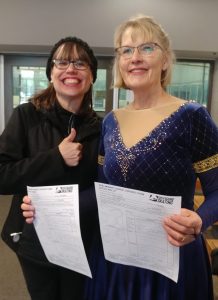
How fast you find out if you passed your test varies based on many factors including: how fast did the judges turn in their sheets, is the test chair able to review the sheets, can they find you to give you your results (don’t hide in the bathroom!) or is your coach available in between other skater’s tests. Either the test chair will give you, the tester, the sheets or give your coach the sheets. Either way you need to study them with your coach. If you are handed the original sheets the test chair will want them back to make copies. However, often the test chair will have already made a copy of the originals so you can keep the sheets you are handed. Make sure to find out if you can keep what you are handed.
The Pre-Preliminary skating skills test is marked by the judges as a retry, pass or honors. The judges are given room on the test sheets to write comments. Remember, they have been standing through your whole test at the side of the rink and their hands are probably frozen. Judge’s handwriting is notoriously hard to read. But take their comments to heart. They are trying to help you by offering these comments.
On higher level tests I also recommend skaters double check the math. Each move will be given a score and it’s been known to happen that whoever added up the scores writes down the incorrect total. I’ve seen it go both ways – to the skater’s advantage and disadvantage. But you need to bring any calculation errors to the attention of the test chair.
If you are able to talk to a judge or the judges I would highly recommend you do! Go with your coach and say “Thank you” to them. Again, they have volunteered their time to judge your test. Judges are not paid. That is considered a conflict of interest. They often will elaborate on any comments and/or help you read their handwriting. They will give you some good feedback and advice. Listen attentively and ask any follow-up questions you have. It’s sometimes hard to hear criticism but if you are a skater who dreams of success and glory, you need to listen to the people evaluating your performance and apply their advice. That’s how you will improve and ultimately reach your goals and dreams. You must change from what you are today little caterpillar to someday skate like a beautiful butterfly!
Attire:
Check with your coach about what is proper attire for your test but at the Pre-Preliminary skating skills level you don’t need a fancy competition outfit. As you continue to test at the higher levels you might then wear a competition outfit. But for a Pre-Preliminary skating skills test you can wear a practice outfit with a jacket that is not too bulky so the judges can see your body lines. Test sessions are usually colder than regular practice sessions so make sure you have layers on that you can take off and still look presentable. For ladies you’ll want age appropriate makeup and hair that is organized in a ponytail or bun.
Coaching:
Check with your coach about payment for them attending your test session. Coach’s test fees vary so ask ahead of time what their fee for test sessions is so you are prepared. Remember, a coach would not tell you that you are ready to test unless they have seen you skate the test to a passing level. Trust your coach – you are paying them for their knowledge and expertise.
By passing USFS tests you will be eligible for different events at competitions and will be increasing your skating skills. There are quite a few disciplines you can test: moves in the field, free skate, pairs, pattern dance, free dance and figures. Some of these disciplines have a prerequisite of other tests to be passed before you are eligible to test. For example, before you are eligible to test Pre-Preliminary Free Skate you must have passed the Pre-Preliminary skating skills test.
Here is a link to all the USFS test forms which the judge(s) will complete as they watch you skate and judge your test. You are welcome to look at the sheets ahead of time to see what they judge(s) will be looking at during your test.
Testing is just an evaluation of your skating on that day at that time. There are no limits to the number of times you can try to take a test. If at first you don’t succeed, try, try again! More details are available here: USFS rulebook. So make sure you give yourself enough time prior to any competition deadlines to try a test a couple times just in case the first time you don’t pass.
Anyone who has watched figure skating competitions on TV has seen the skater’s private lesson coach(es) standing at the wall, giving last minute advice, and then stepping back to watch the performance along with the judges and spectators. The coach(es) have supervised the creation of the whole package that is being presented on the ice by the skater. Their role is to physically and mentally prepare the skater for this moment. So how do you choose the right figure skating private lesson coach(es) in ice skating to mold you into the shining star of your dreams?
Let’s explain a few general things first on how figure skating coaches operate. Unlike gymnastics or swimming where most of the learning happens in a group situation, figure skating is primarily taught through private (one-on-one) lessons. When a skater is just starting out, Learn To Skate group lessons are a good choice. But once a skater wants to compete in a competition, perform in an exhibition, recital, ice show, or pass a specific test, then you’ll need to find a coach (aka: instructor or figure skating professional) to take the skater through this next step: cut their music, choreograph their program, help them learn their program and improve the elements in their program.
Note: you should expect to pay the ice rink an extra fee for any ice time you skate when you are taking your private skating lesson. This could be a public session, freestyle session, or some other type of session - the options vary greatly from rink to rink. Your private lesson coach will help you find the appropriate sessions for you to skate on.
You need to be shrewd as to who you choose as your figure skating private lesson coach. I’ve seen some special bonds develop that last a lifetime. Your private lesson coach is a teacher of figure skating, but often they also become a mentor, adviser, and counselor.
Things to consider when choosing a figure skating private lesson coach:
- Availability: does the coach have time to take on a new student? Ice time is limited where coaches are allowed to give private lessons, so you need to find a coach who has time available to teach a private lesson when the skater can also be on the ice.
- Cost: what is the coach charging for a private lesson? Does that fit into your budget? The amount a coach charges depends on the city (New York City vs. Kansas City), their skating accomplishments, and their coaching accomplishments.
- Teaching styles: personalities are important and have to be a good match. Is this coach someone who the skater will take instruction from? Some coaches push their skaters hard and demand a lot with minimal positive encouragement. Other coaches are encouraging and pull their skaters with lots of positive encouragement. You need to consider what is the best teaching style for the skater to thrive. I’ve seen both work really well with the right skater.
- Learning styles: every coach has a way of communicating. Does it mesh with your way of learning? Does this coach demonstrate skating moves, give verbal corrections, or are they more hands on and help the skater feel certain positions? Or some combination of these? Is the skater a visual, auditory or kinetic / tactile learner? Can the coach teach their theories and techniques so the skater will grasp the concepts?
Who is a figure skating private lesson coach at your rink:
1. Look around the rink’s lobby or online: often the coaching staff have their pictures posted and sometimes there are bios, rates, organization memberships, and contact information too. If you need to look online, make sure you check the rink’s website and the home figure skating club’s website for the coach’s information. It just depends on the facility as to where you will find this information.
2. If no information is visible then ask the Skating Director: sometimes you need to ask for this information for privacy purposes. They should have a list of coaches with their photos, bios, rates, organization memberships, and contact information for people like you who are looking for private lesson coaches. Occasionally the rink may write down your contact information and have coaches contact you directly.
Ask for a trial lesson:
If the skater is in group classes, who is the skater’s current Learn to Skate coach? Since there is a relationship started here this is commonly the first person to ask for private lessons. However, if there are other coaches that you determine might be a better fit for the skater, feel free to approach them. My recommendation is to individually approach each coach you are considering and start a conversation.
Exploratory discussions points:
1. Is the coach currently accepting new students?
2. Does the coach have time to give one to three trial lessons to a new skater?
3. When can you schedule the trial lessons that works for both you and the coach?
Explain to them that you are looking for a figure skating private lesson coach and that you would like to take a trial lesson with a few coaches to see who is the best fit. Open and honest communication is the key. It’s very import that you are upfront and tell the various coaches that you are conversing with other coaches.
I like the term trial lesson because the skater and the coach are both trying out the relationship and both parties will need to approve for these skating lessons to continue. And if the skater is young, this relationship triangle of skater, coach, and parents needs to be positive all around.
Even if a coach says that currently they have no room to take on a new student, see if they will still give you a trial lesson. It's possible this is the coach you prefer and they will put you on a “waiting list.” Sometimes skaters depart the sport or move away. Also, during the summer there is often more ice time available for private lessons, and you can then start with them as your private lesson coach.
A trial lesson is great way for you to see how the skater connects to the coach without committing to that coach yet. The next step is to schedule one to three trial lessons with each coach, reconfirming that you are only committing to trial lessons at this point.
Decision time:
Once you have had your trial lessons and you are confident with a specific coach, and the coach also agrees and accepts you as a new student, then you have officially selected a figure skating private lesson coach. Congratulations!
Note: make sure you also communicate with the coaches you do NOT choose. They need to know that you reached a decision and what that decision was. Realize that situations change over time. It might become necessary to choose another coach in the future and you don’t want to “burn any bridges” with other coaches due to lack of communication.
Comprehensive discussion of goals, policies, and procedures:
This private lesson coach will now be your head coach, or primarily coach, and will be your official guide to helping you achieve your skating goals. Together you will need to create a skating schedule that allows for enough lessons and enough practice time to achieve those skating goals. You should also talk about skating tools, equipment and a budget that adequately supports the skater's goals.
Some additional questions you should ask your figure skating private lesson coach:
- How and when do they want lesson payment? If they bill, how often? How much do they charge for various things such as test sessions and competitions? What are the additional charges for out-of-town competitions?
- What is their lesson cancellation policy? What happens if the skater misses a lesson without 24-hour notice? What is their preferred form of communication?
Note: generally most coaches have a 24-hour advance cancellation notice and will charge if the skater misses a scheduled lesson. However, what if the coach misses a scheduled lesson? What is the coach willing to do to make it up? If I miss a lesson, without giving advance notice, my policy is that the skater’s next lesson is free. However if there are "x" amount of lessons per week scheduled and the coach can fit the skater in at another time, so they end up with the same amount of lessons without buying extra ice, then usually a free lesson isn’t given.
- What is their philosophy about skating? What do they consider their strengths as a coach? Weaknesses? What do they love to teach?
- What competitions, seminars, camps, ice shows, exhibitions, recitals or tests are possibilities in the next six months? Year?
- How do they notify you if they will be gone? How far in advance do you get notice? Do they have another coach fill in and teach their regularly scheduled lessons while they are gone?
- Do they team coach? If so, with whom?
If your figure skating private lesson coach does team coach, here’s some general information about team coaching: you can have a private lesson coach, a moves in the field coach, an ice dance coach, an off-ice coach, a jump coach, a spin coach, etc., or any combination, including just one coach that does it all. Pick your primary lesson coach first and from there see what coaches they are willing to work with. Coaches who teach in the same style tend to work together which keeps your skater from being confused by learning different techniques. Make sure you get specific details about how these coaches work together so there is no miscommunication.
- How many meetings a year are expected? Is there a charge for them? If so, is it the coach’s hourly rate or something different? Or are two meetings free (pre and post season) with an hourly charge for more meetings?
Beware: excessive phone calls and emails can be charged for as well. Please remember the coach has other students and a home life, so boundaries need to be set as this can sometimes become an issue. Realize too that grabbing your coach for a quick minute during an ice resurface might not be a good idea as they may be running to another rink to teach, etc.
My recommendation is that you keep a skating lesson notebook. I highly encourage all skaters to have this with them out on the boards during their skating sessions. It's a great way to remember certain key phrases or words from your coach when working on your program, jumps, spins, moves, dances, etc. And it's a great place for your coach to write down what is important to remember from your private lessons. If the skater is young, it can also be a way to communicate with the figure skating private lesson coach.
Lastly, be respectful to your figure skating private lesson coach. Be on time to your lesson. Be warmed-up and ready to go. Be attentive and willing to try. Hopefully, you had time to practice what you learned in your last lesson so you can show your improvement in your next lesson. You are paying your coach for their skating expertise - don't argue with them - listen and try! Ask questions if you don't understand.
Your coach’s objective is to help you achieve YOUR skating goals and dreams.
Figure Skating Bag - Beginners:
Make sure you have everything you need when you get to the ice rink. It’s a good idea to go through your figure skating bag at least once a month to remove accumulated “stuff”. Some of it will be trash (armbands from old sessions, empty tissue packs) and some of it might be important like flyers about upcoming events or registration forms. Here's a list of items that should be in your figure skating bag:
- Your ice skates.
- A cloth for drying your blades. I use a washcloth. It's very important to get your blades dry before storing them. You don't want to have rust on your blades.
- Guards for walking - also called "hard guards".
- Blade covers or "soakers" for protecting your blades in your figure skating bag.
- Extra knee-high skating socks.
- Gel tubing sleeves - only use if ankles need the extra layer so they don't hurt in your ice skates.
- Wrist guards, elbow and knee pads.
- Helmet / headgear / head guard / cushioned stocking cap - something to protect your head.
- A spare outfit in which you can skate comfortably and safely in case you arrive in non-skating clothes by accident someday.
- Gloves or mittens.
- A jacket.
- Water bottle.
- Small sewing kit with extra safety pins.
- Extra hair ties and clips to keep your hair back and secure. Brush or comb.
- Payment for your sessions - some rink have paper passes for freestyle and public sessions, some have a card-based system and others are cash only.
- First Aid kit with bandages and pain medication. If you have allergies or asthma, make certain you have emergency medications and that your coach and two trusted adults know where they are. If your child is old enough to self-administer their medication, they need to know where it is as well.
- You should also have a list of emergency contacts. Again, make sure your coach and two trusted adults know where it is. Include a copy of your health insurance information and medical issues (drug allergies, etc.) as well.
Figure Skating Bag - Training:
Now you are skating a few times a week and are training for an upcoming show, exhibition, test or competition. Here's a list of additional items that should be in your figure skating bag:
- A pair of tennis shoes / sneakers for warm up and off-ice conditioning.
- Dance shoes if you take dance at the rink.
- Training equipment such as jump rope, spinner / TurnBoard, stretch band, Champion Cords, ankle buzzer and yoga mat. (Look on the Tools of the Trade page for an in depth description of some of these items.)
- Bag to take out on the ice to the boards with tissues, water, gloves, lip balm, extra hair ties and clips.
- Small notebook and pen or pencil.*
- Hip and / or tailbone pads.
- Music - fun, motivational music for warm-up and for each program you are training. Rinks play music from ipod, phone, jump drive or CDs.
- Healthy snack.
- Extra knee-high socks or practice tights.
- Roll of sport wrap.
- Extra laces for your skates.
- Safety pins and a travel size sewing kit.
- Screwdriver for tightening your blades. Check to see that your screwdriver matches the style of the screws in your blade.
- For older girls - personal hygiene items.
- Pain medication.
- A copy of USFS and / or ISI membership card.
*Small notebook and a pen or pencil: I highly encourage all skaters to have this with them out on the boards during their on ice skating sessions. It's a great way to remember certain key phrases or words from your coaches when working on your program, jumps, spins, moves, dances, etc. And it's a great place for your coaches to write down what is important to remember from your private lessons. If the skater is young it's also a great way to communicate with the coaches if there is no time in between lessons to catch them to chat.
Figure Skating Bag - Competition:
Congratulations! You've been training hard and now you get to perform and show everyone how much you've improved. It will be fun to show the audience, your coach and the judges how much you enjoy ice skating! Here's a list of additional items that should be in your figure skating bag for a competition:
- Your registration information with event numbers, times, rinks, etc. Make sure your coach has a copy of this too.
- Some competitions require proof of age. For a young skater a report card usually is sufficient.
- Two extra copies of your music - one for practice ice and one for your coach to have as a backup for each event in the competition.
- Clean tights with no holes and competition dress.
- An extra pair of clean tights with no holes and another dress - just in case.
- Clear nail polish to stop any runs in your tights if you don't have time to change your tights. Traditional "brown" band-aides also work well in a pinch as you can put the band-aide on your skate then the hole in your tights is not as noticeable on the white skate.
- Something comfortable to change into after the competition.
- Hair and make-up: Skaters should get ready at home or in the hotel room and only bring with them what they need to do touch-ups. Ice rinks have notoriously bad lighting, very little counter space, small mirrors and few power outlets for curling irons, flat irons or hot rollers.
- Things to pass the time. Maybe a deck of cards, reading material, game system or tablet.
- Fully charged phone, camera and / or video camera including charging cables and extra batteries.
- Extra water and healthy snacks.
- Money. Depending on the size of the competition there are programs, flowers, bake sales, vendors with tables of skating items, etc.
- Good luck charm or competition buddy.
- A smile, positive attitude and belief you are going to perform the programs just like you have been training them.
So there's a competition far enought way that you want to fly to compete. You've looked online and found that the airfare is reasable! Score! You talk to your coach and it's a go. So you start thinking - do I need to send my ice skates via FedEx ahead of time? (Hate to be without them for a couple days...) Can I check them in my luggage? (But what happens if my luggage gets lost?) Or can I possibly carry them on?
According to this website, the TSA.gov website under the "Sporting Goods", you can take your ice skates onboard a flight as carry on luggage. However, I suggest you check this site before each flight as this could change anytime.
There have been reports, such as 2011 National Solo Dance Championships, where a competitor was prohibited from taking her figure skates in carry-on luggage and the unthinkable did happen. Yup, the airline authority, who didn't let her keep her skates or her dresses with her, temporarily lost them. The competitor did compete - but in rental skates! However, this is the exception to the rule...
NOTE: Type in "ice skates". If you type in "figure skates" it comes up: Sorry, no results found at this time.
Another option is to send your ice skates with someone else who is driving to the same competition. I've taken my student's skates to Lake Placid by car so they didn't have to deal with this issue when they flew. You might be without your skates for a few days but you know who has them and where they are.
Good luck to you and "May the skates be with you".
FAQ
Answers to Many Questions
Generally figure skates are easier to learn to skate on as their blades are longer and the toe pick can prevent some falls.
Here's a 2 min video from Learn to Skate USA that shows how to tie FIGURE skates!
Here's a 2 min video that shows how to tie HOCKEY skates!
It's far easier to glide on fresh clean ice but you do tend to glide faster which requires more balance and control. Rough ice is probably preferred for beginners as it's not so "slippery" and not a fast when you do glide.
I recommend:
• Lightweight gloves as the ice is cold to touch.
• Bring both light and heavy long socks (over the ankles) as rental skates are only available in full sizes. This way you can adjust your socks to get the best fit possible.
• A helmet or stocking cap with a thick or folded brim offers protection and is recommended.
• Wear layers as you'll get warm skating.
Skating teaches so many skills such as balance and body awareness that getting on the ice at any age and having fun is really learning! The smallest rental ice skate EPIC has is a youth size 9.
The best age to start formal skating lessons is when a student can listen, follow directions and stay focused for 15 to 30 min - so it varies. But I always recommend going to public sessions and just have fun to see if there's an interest in skating first before investing in lessons.
Yes! Group lessons are offered at EPIC but do tend to fill up fast. Look at the Recreator [fcgov.com/recreator/] for group lesson dates and times.
EPIC's public skate / open skate ice times as well as the fitness skate ice times are listed under "ice skating drop-in program schedule" found here: fcgov.com/recreation/epic/ Just make sure to check the tabs at the bottom for the weeks as the schedule varies.
Here are the rates and fees for admission and skate rental as well as group rates: fcgov.com/recreation/recpass.php
There is a monthly calendar put out by EPIC that shows the ice times where skaters can practice their programs to their music and skating skills for upcoming competitions and tests. You can pick up a hard copy at the EPIC front desk or the Fort Collins Figure Skating Club posts it: https://fortcollinsfsc.org/epics-ice-time
The Fort Collins Figure Skating Club (FCFSC) is a a volunteer organization whose mission is to create, maintain and enhance a healthy and positive environment in which our members can develop physically and emotionally while building character through the sport of figure skating at all ages.
Skaters join the FCFSC so they can participate in the club's annual ice show, compete at various competitions, take US Figure Skating tests and attend our social events. More information about the club can be found here: fortcollinsfsc.org
Thank YOu
I'm so glad you are here! I'm a huge cheerleader for the sport of figure skating.
This website is a resource for skaters and parents / guardians. Topics are all about skating but none are "how to skate". While there are techniques for learning different skills in skating, teaching someone "how to skate" is best left to a coach who knows more details about the individual skater including their health history, skating history and specific skating goals.
I want everyone to love the journey of learning how to dance to the music on frozen water with knives on your feet! ;)
Katie's Rates / Policies are available upon request for test sessions, competitions and cutting music.